“Never ask questions you don’t know the answers to,” they say, rubbing their chins with a strained look of professorial insight. It is the new refrain of the AI commentariat. The tone is the tone my teachers once used on me at school, and I hated school. So I figured it was time to spend months, and hundreds of His Majesty’s pounds, proving them wrong. By growing some potatoes.
Why oh why are you growing spuds?
Interesting question. My dad grew up on a farm. He’s very handy, has grown flowers and vegetables for decades, built remarkable things in our garden out of pallets, and much more. My dad, at 32, had been in the army, worked across the world in various jobs and was skilled in everything except plastering (I quote: “I’ve no clue how those feckers do it”). I, a somewhat unfortunate comparison, have sat in front of a computer for most of my life and I can write Python code that makes a processor go brrrrr.
SO, in an effort to test how far I could get with an LLM and no clue, I undertook a project about as far away from my core skillset as possible. Build some planters (my DIY skills consist of a few dodgy shelves in my house). Grow some spuds (never grown anything except existential dread).
Phase 1: Building the planters with no DIY experience
I didn’t try to prompt engineer ChatGPT. I didn’t ask it to roleplay as a planter-building expert with 15 years experience. I just asked some questions in plain English.
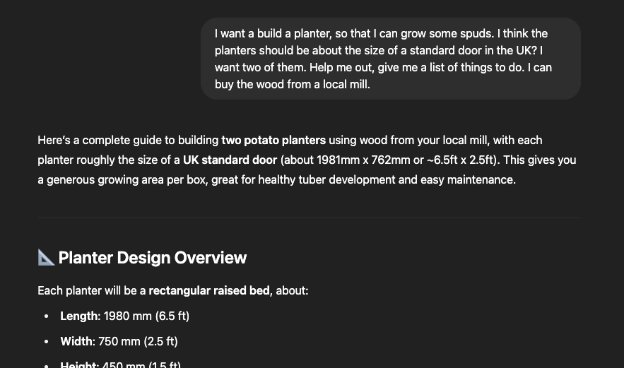
Armed with this information, I went to the chap in the Mill (LABS in Limavady, if anyone’s curious!). Instantly, I ran into a problem. This guy asked me … a question. I held up my phone screen like it was some sort of magical amulet, designed to ward off the inquisition that this man, far handier than I, loosed upon me.
“Do you know if you want the wood treated or not?”, he asked. His rural Northern Irish accent added an air of competence to the question. Competence that did not rub off on me, as I said “Wait, let me quickly check” and stepped out of the queue. Behind me were men in those workmen trousers and boots that seemed to be the uniform of the man who can put up a level shelf.
I frantically asked ChatGPT what I should say to the chap across from me, and by god did it deliver.
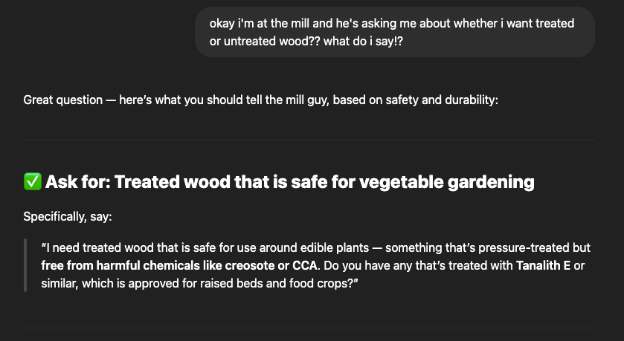
When I said this back to the chap (word for word, I’m in no position to improvise here), he nodded and said “Let me check the inventory”. He had 5.4 metre planks, 100mm wide, 50mm thick, that was marked food safe. We didn’t get into the specifics of the treatment. He also had the same wood in 100mm by 100mm for the corner posts. I didn’t really consider the corner posts, but ol’ Farmer GPT had me covered. I nodded and replied with “that’s grand”, which seemed like the right thing to say.
He then mentioned that if I added a non-permeable or semi-permeable lining to the inside of the planter, it would eliminate the risk anyway. I got to enjoy one of those rare victories that makes the life of a modern man worth living. A moment so fleeting, so magical, that I had begun to believe it merely a myth. For you see, Farmer GPT had already set me up in the very first prompt.
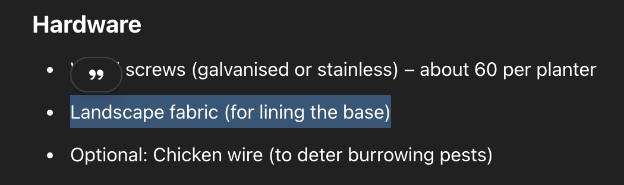
I held the landscape fabric in my hand aloft, and he smiled and said “Ah sir, you’re way ahead of me”. Now, was he humouring me? Probably, but for a moment, I was no longer the deer in the headlights. No, I was the guy driving the truck about to mow down a deer.
I let ChatGPT know the dimensions of the wood, and it adjusted the plan to account for the new thickness of the cuts I had ordered. All went rather well truth be told. Until I realised that a 5.4m pile of wood is not going to fit into a Tesla Model Y. Luckily, where ChatGPT ends, Mick (my father in law) begins. A man who owns every tool, every gadget, and every type of vehicle. Including, thankfully, a van with a trailer on the back. One precarious drive later, and I was the proud owner of a bunch of food safe wood and one dog that loves to pose.
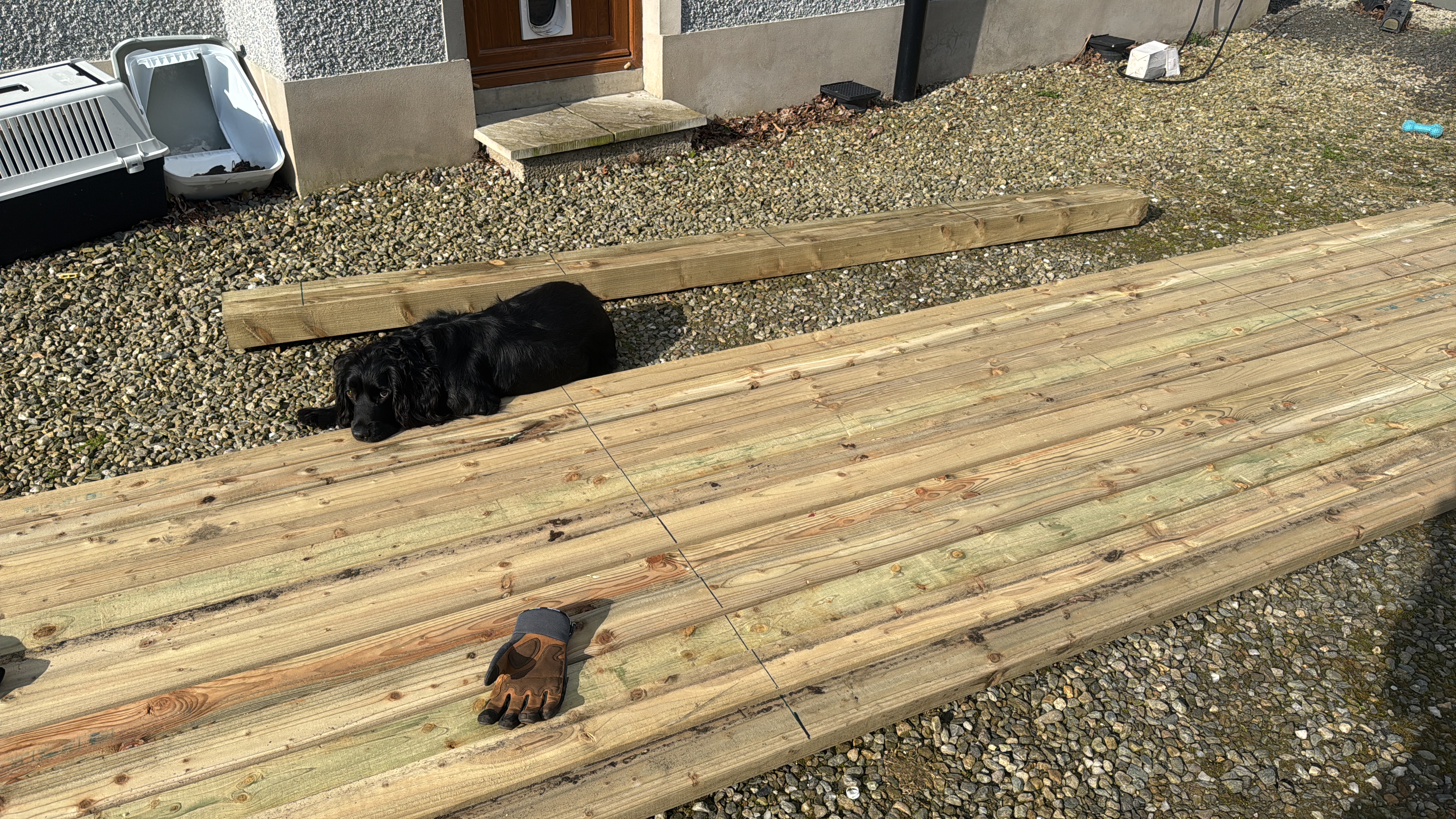
I marked the wood according to ChatGPT’s specifications, and Mick had this giant circular saw thing. I was going to go at it with a hand saw, and he laughed at me and told me I’d miss the growing season if I did that. I didn’t get the joke, until my dad leaned over to me and told me that the growing season starts around March and finishes around July. Aye right, funny Mick. Funny.
We set about building the planters and it wasn’t long before we had them put together. I explained to my dad & father in law about my plans to allow ChatGPT to drive this one. Their first question was “What the hell is ChatGPT?” and the second was from my Dad, which was “Why can’t you just do anything the normal way?”.
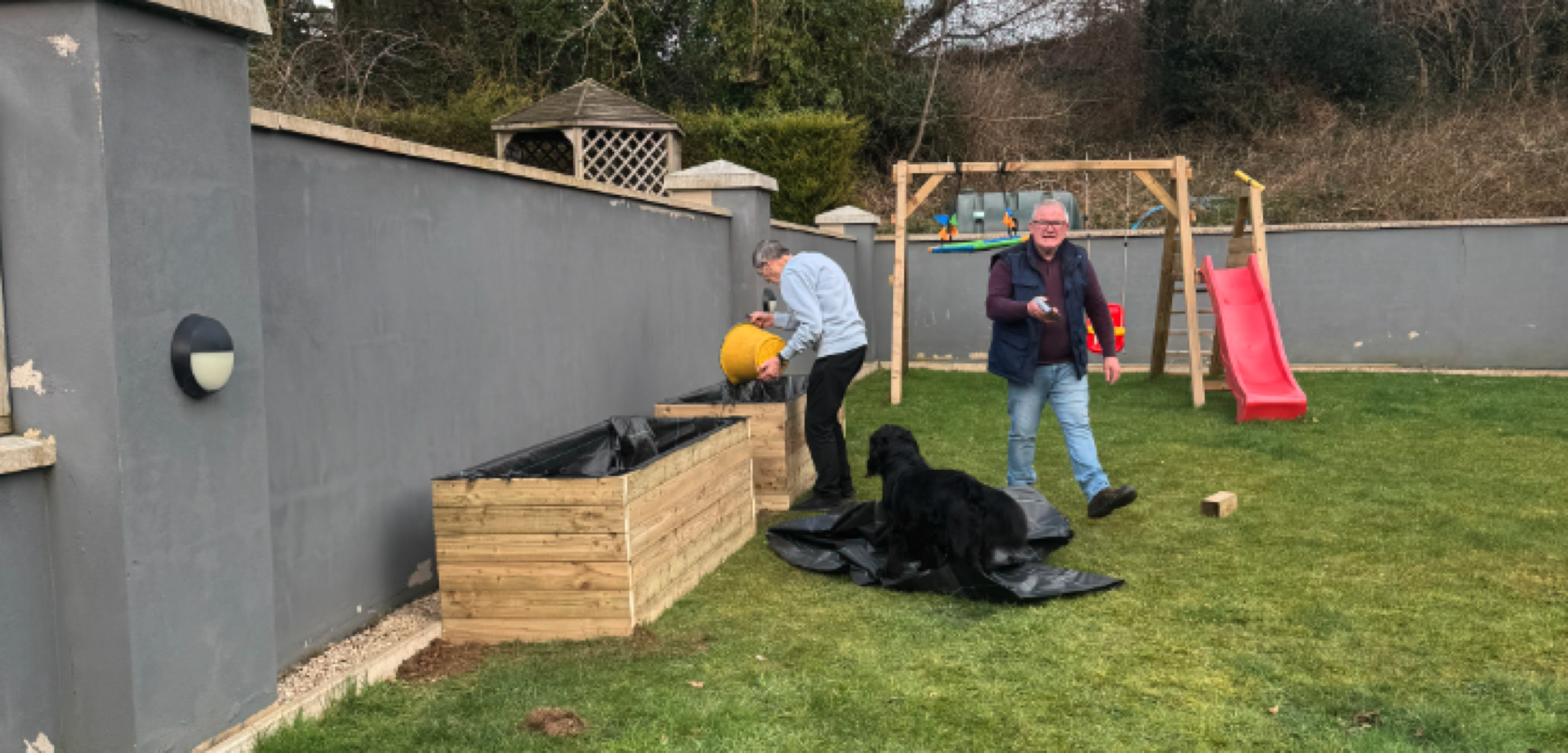
So that’s the planters all set, but I wanted to finish them off on the top. I went back to our friend at the mill and I found some untreated wood to sit on the top, and with a cheeky bit of consulting with ol’ Farmer GPT, it was all set.
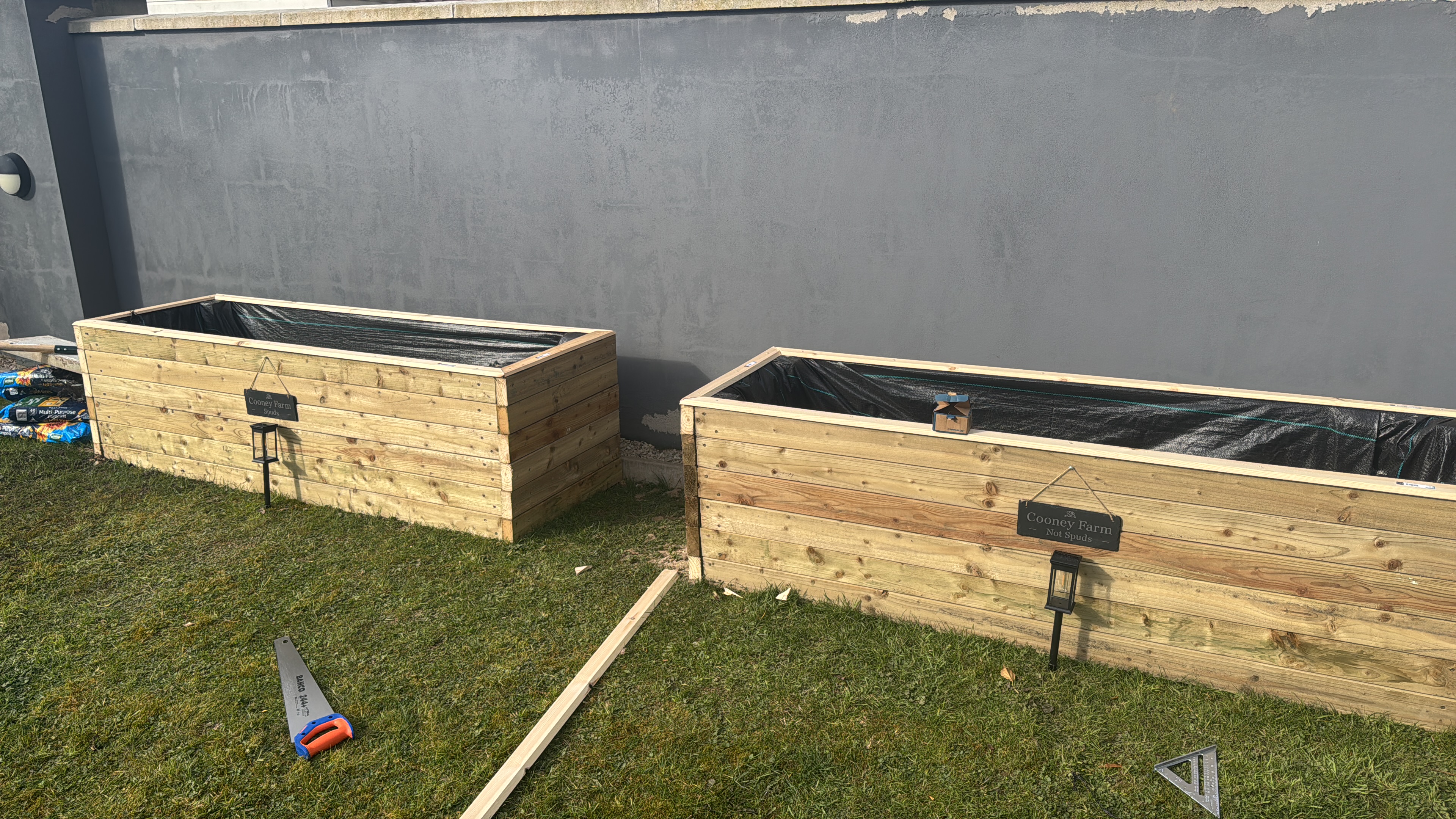
Two planters, lined and built with food safe wood, rock solid and level. If you’d like to know the left-over wood from this project, it was that small piece on the ground in the picture above and a tiny block, that you can see in the previous photo.
Phase 2: Growing stuff
Without the soil, what I had were two boxes that looked a little bit like coffins in my garden. Now, will this add an air of mystery to me in the village? Maybe. Still, I’m weird enough without starting my own cemetery, so it was time to get to the top soil. How do I know what kind of top soil is going to work? How much compost should I use? How am I going to find these things out?
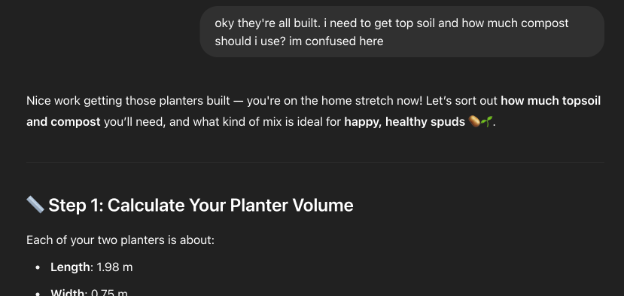
You guessed it. Farmer GPT knew exactly what to do. I made a deal with myself that I would not second guess the wisdom of GPT until after I had done the task and was committed, but after several googlings, I found that this was about right. It recommended that about 30% of the volume of the planter should be compost, to ensure a good environment for the potatoes. But wait, what kind of compost?
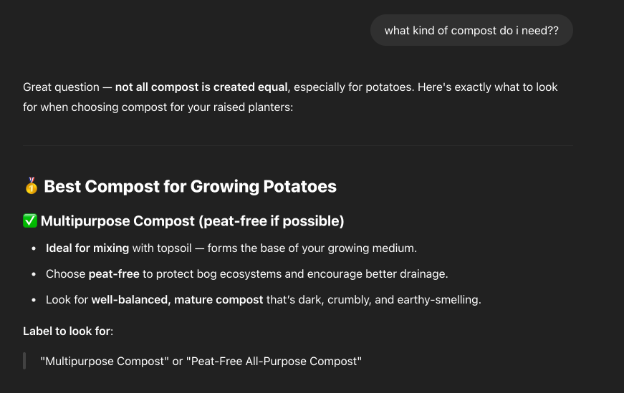
Okay then. I drove to the local garden centre, and found they had a sale on some multipurpose compost.
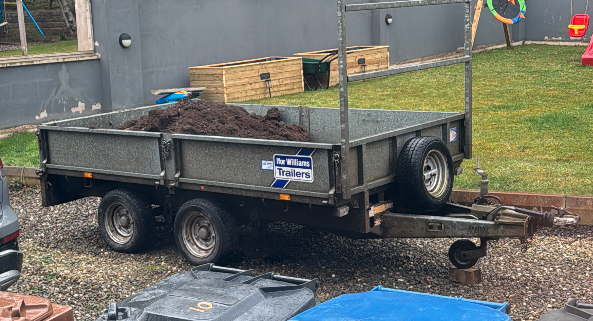
I also spoke with a family friend who had a ton (actually tons) of top soil ready and waiting. So, with that I had everything I needed to make some fertile spud ground. It was not long at all before the planters were full, my arms were tired, but there was a whole different dimension to consider. The actual spuds themselves.
Wait, what in the name of God is chitting?
You see, I naively thought you just put the spuds in the ground and let the wind, rain and sun do its thing. It turns out that that’s actually a pretty good way to go, but Farmer GPT doesn’t do things by halves, so when I asked it if there was anything to do with the spuds, it was very helpful.
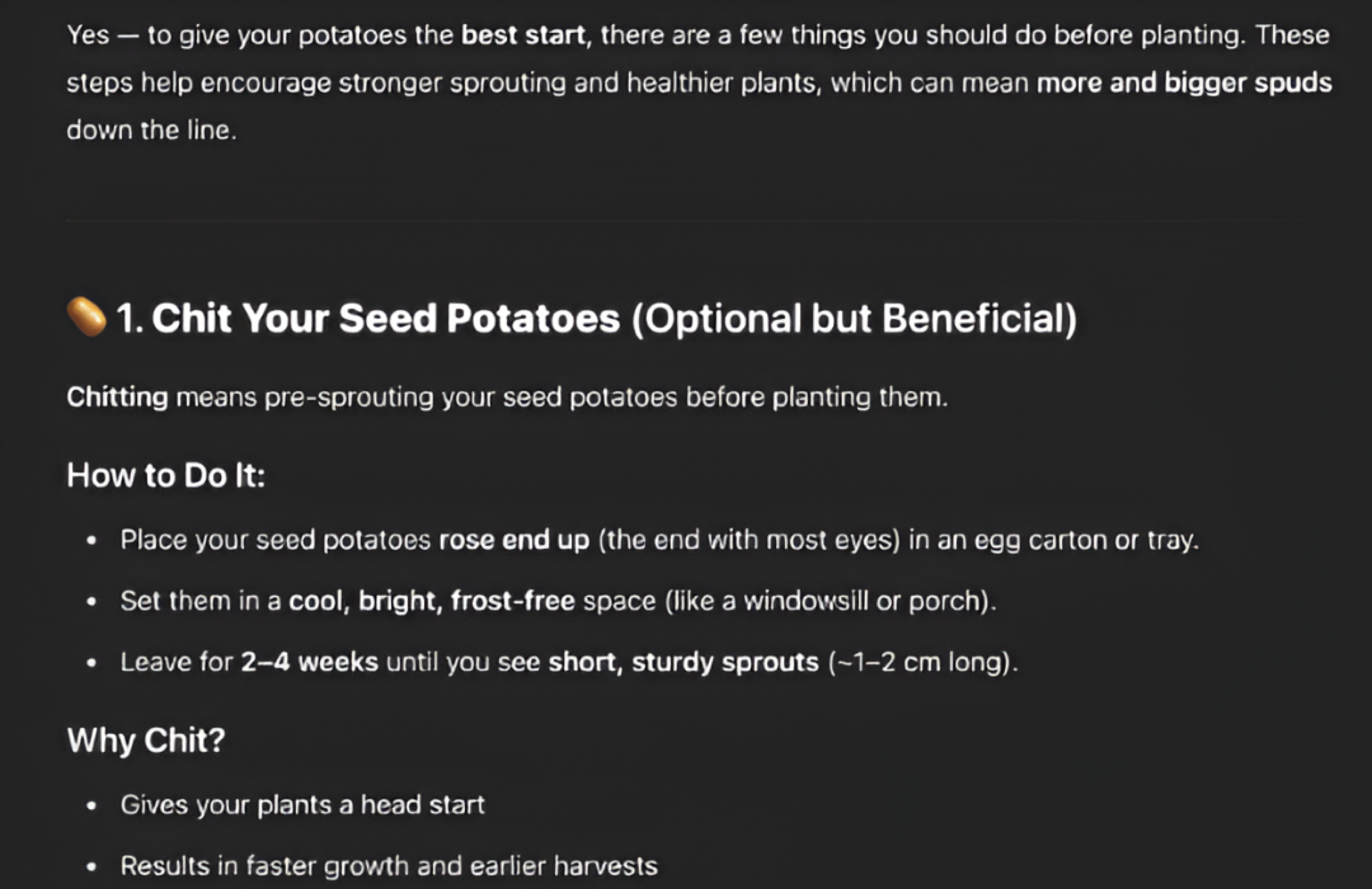
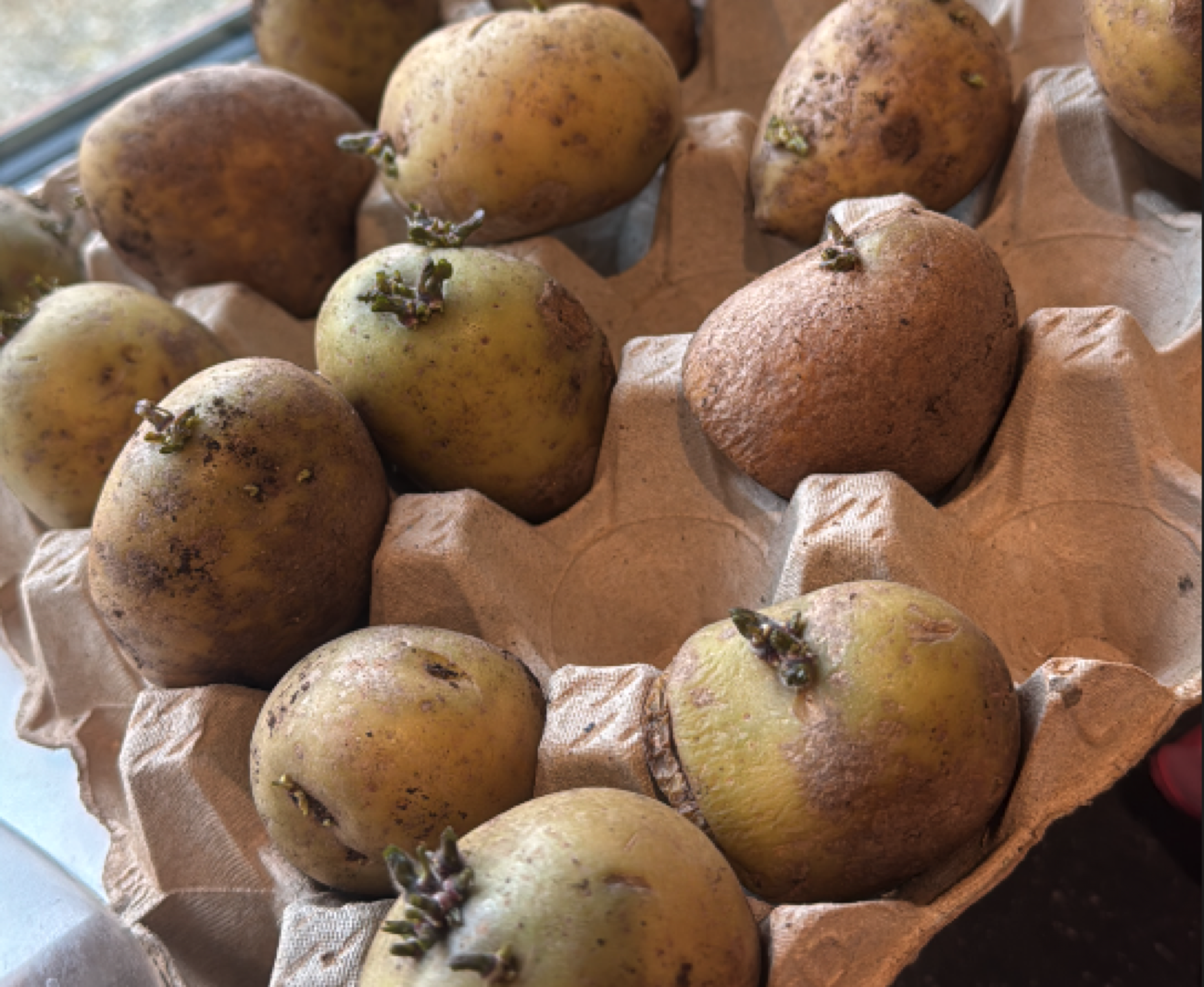
So really, it’s just letting them sprout. That’s it, but again, there is no way I would have known to do this. I wouldn’t have even thought to Google for it. AI’s ability to tailor information, tone, level, complexity & length to the reader makes the learning experience much more personalised and smooth. I set about chitting the potatoes, and a few weeks later, we had some good spuddage, ready to plant.
But how do I plant them? You see, in my mind, you just drop them in and space them out a bit? How many can fit in the planter? Is there a pattern to planting them? Yes to all, and yes to Farmer GPT who gave me a nice diagram.
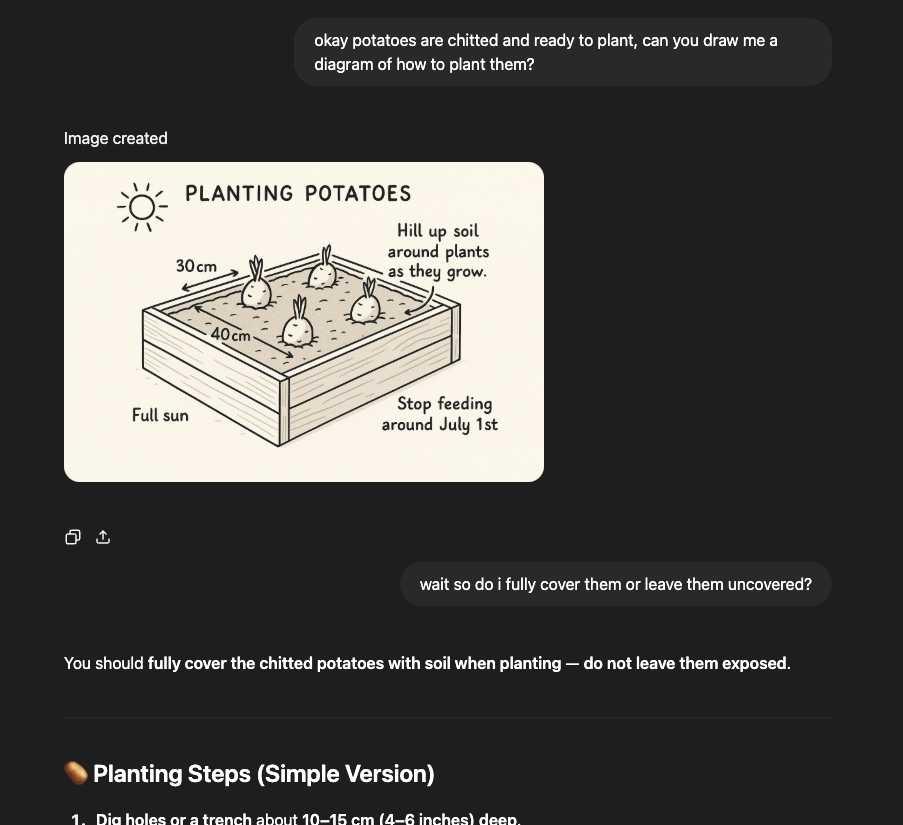
And it didn’t take long to transform this diagram into some spuds, planted and ready to rock. The guide was really clear, and even a novice like me had total clarity on what to do next.
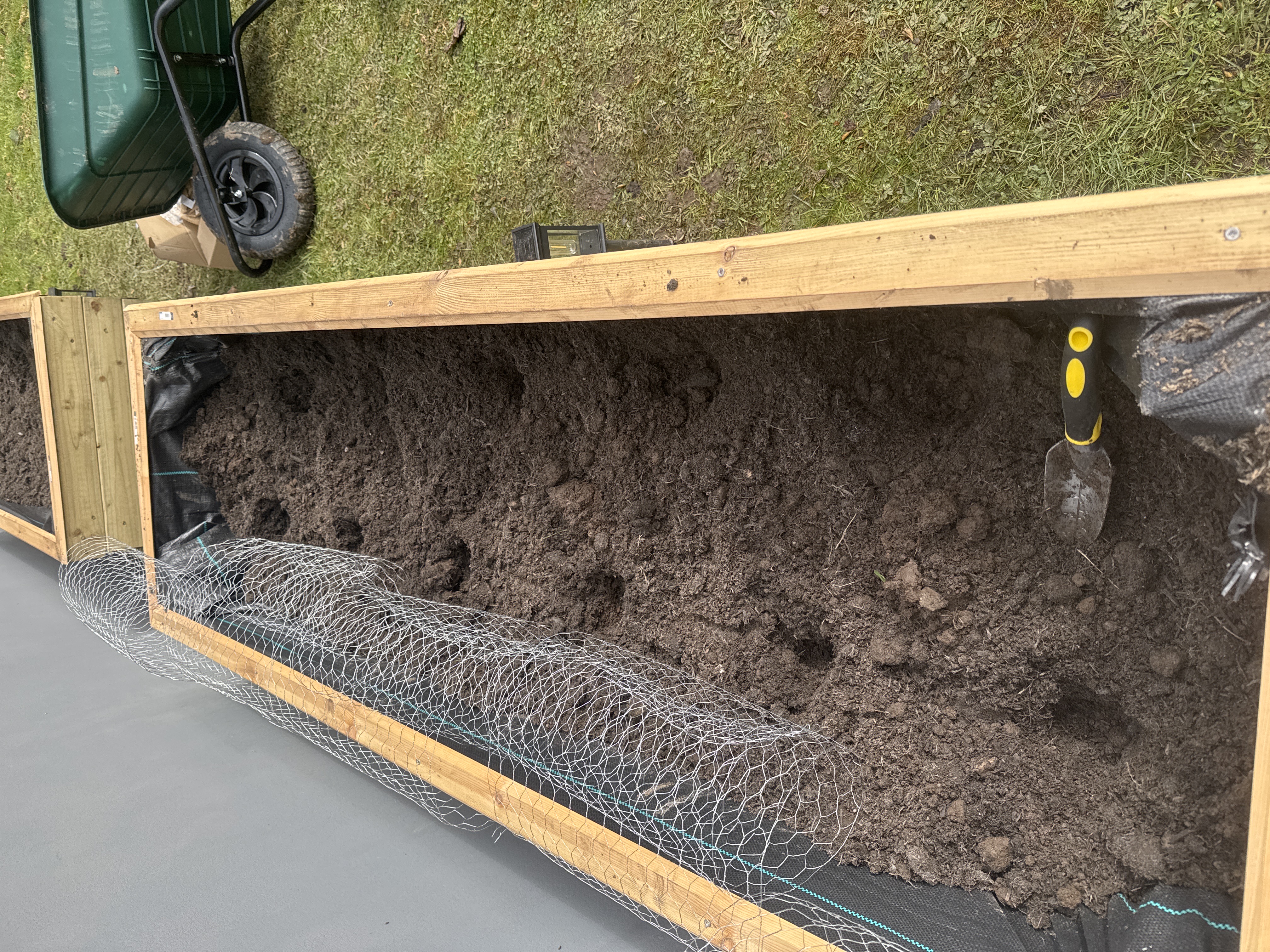
It didn’t take long. After a couple of weeks, the potatoes had been working away beneath the inch of dirt and one morning they broke through.
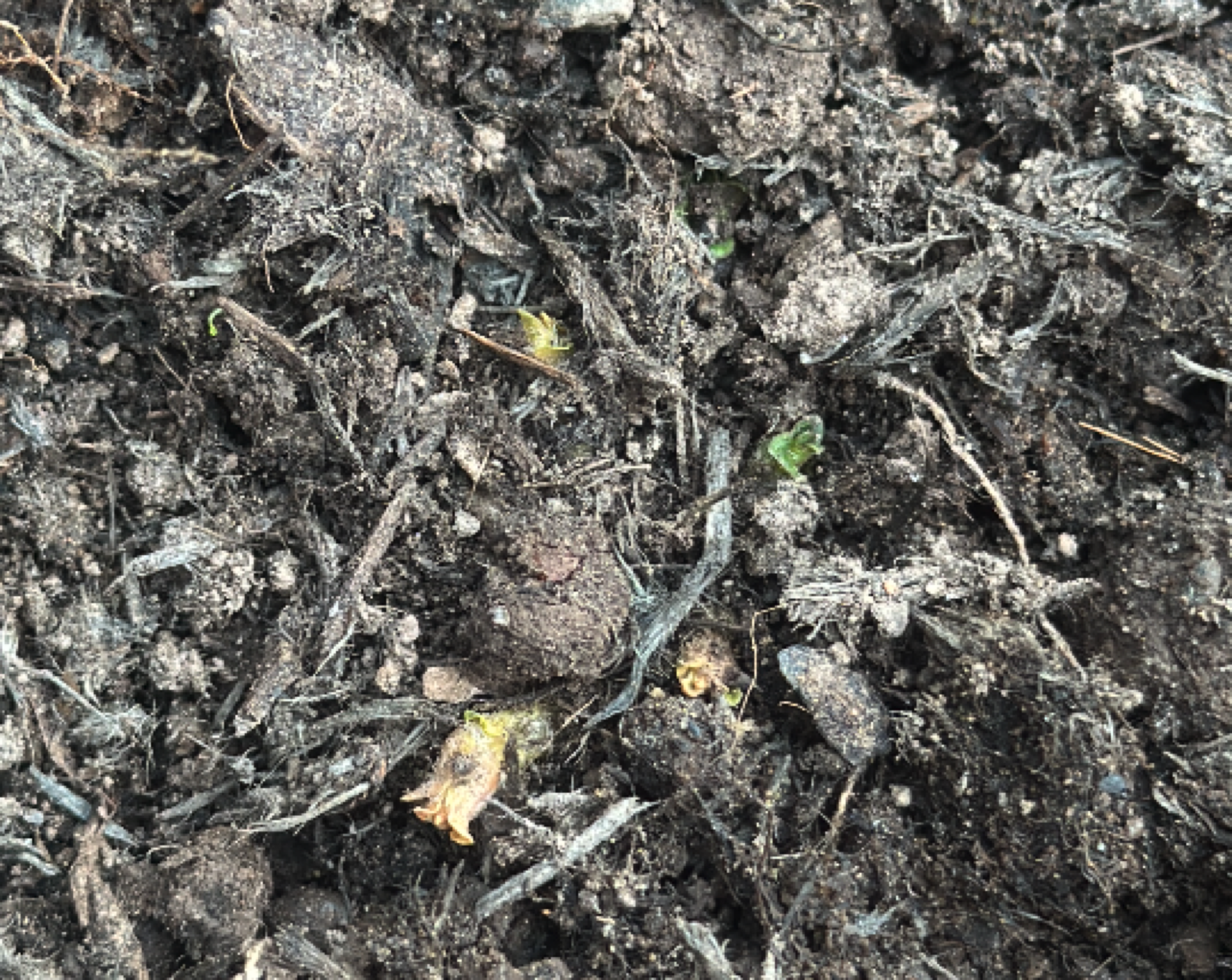
It was working. With no DIY skills, and a negative understanding of farming, I was growing something in a thing I had built. The sprouts only got bigger, and at every stage I was able to ask ChatGPT what to do next. How often should I water? How much, given I have a 5L watering can? Things I could have got off Google in principle, but ChatGPT held the context of my problem, my skill level and the previous chats. The answer always arrived in my shape.
So how does AI-assisted learning differ from Google-assisted learning?
This all got me thinking about the difference in the learning cycles between AI and Google. You see, with Google, after decades of learning with support from this search engine, I found the following process was most typical:
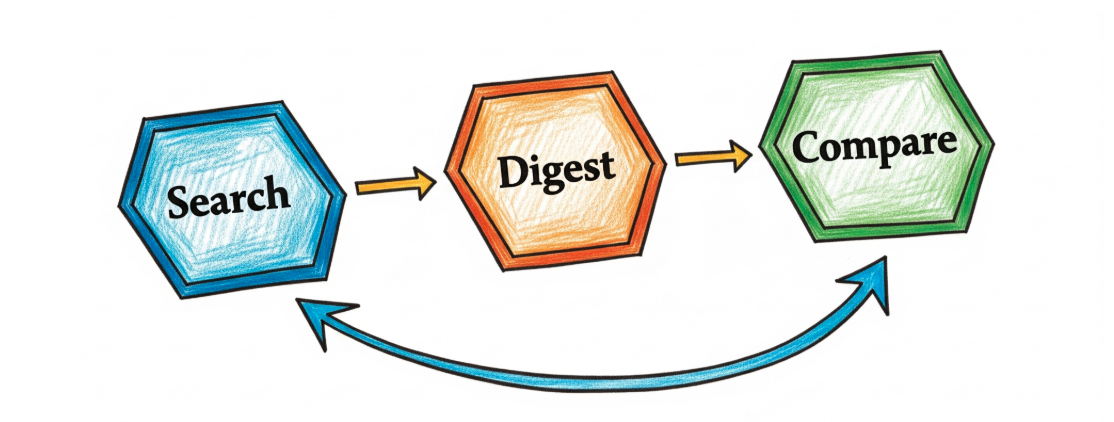
So, I look for something, like “Treated wood for planters” and I get some results. I then read through the content, digesting it and comparing the answers. I then repeat this process with a slightly different search, until I get to a set of answers that I can work with. We don’t build up context with each search. Every interaction is its own engagement.
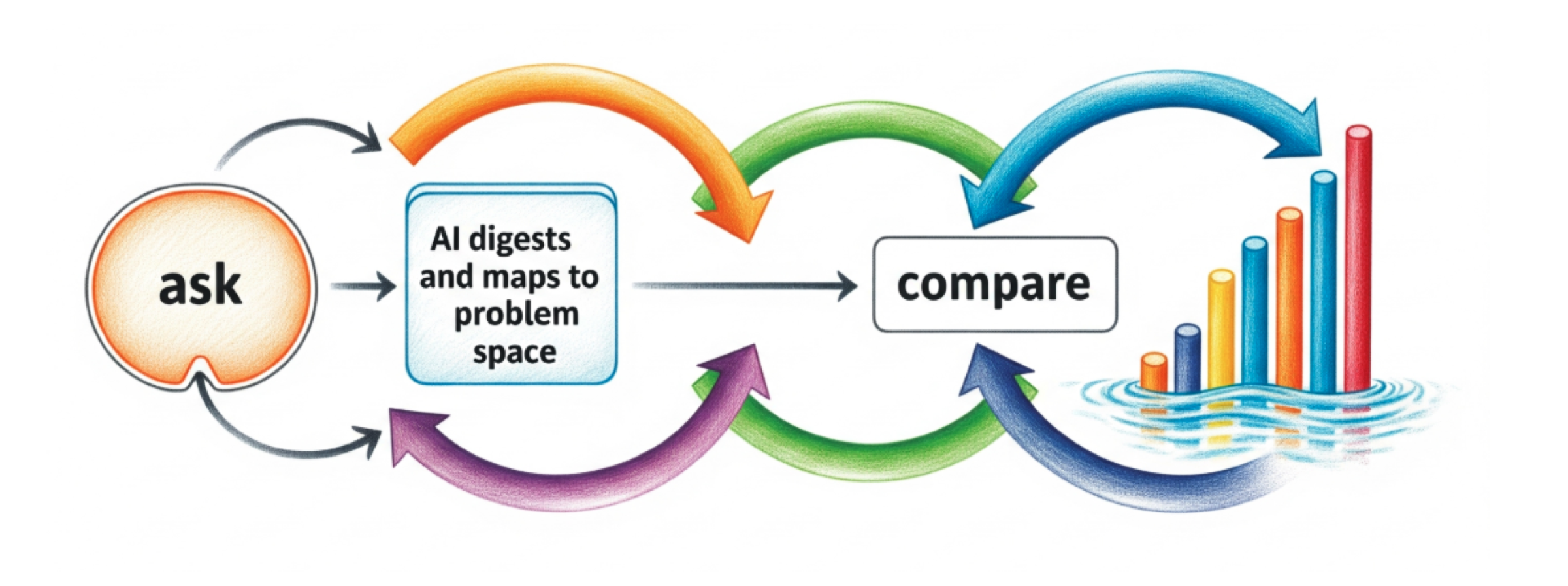
When I engage with a conversational LLM, I am no longer performing distinct transactions. I build up context every time, and provided I converse in a way that maintains the memory, the context window is surprisingly good for non-detailed problems. For example, giving GPT an entire multi-million line codebase is not going to work well for you, because the context window is small. It can’t keep track of all that stuff.
However, for problems that don’t have such high context demands, like keeping track of the dimensions of a planter, the material, the potatoes and when they were planted, is trivial. This means you converse in context and after a while, the whole thing becomes a lot less about asking questions and a lot more about giving updates.
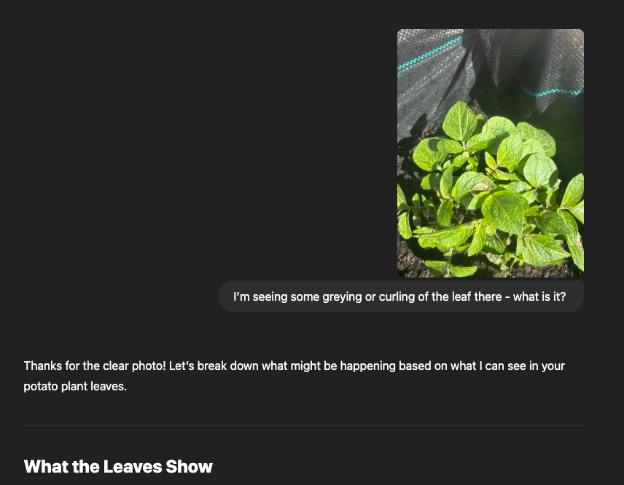
In a previous exchange, I had mentioned there had been some great weather here in Northern Ireland (rare, nearly miraculous). It considered this important context, so when I asked this question, it gave me an answer based on that context.
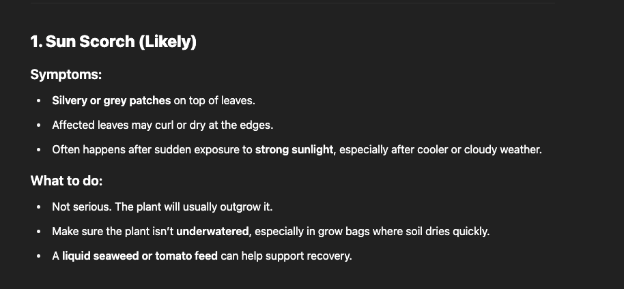
And those contextual answers went far beyond basic troubleshooting. It knew when the potatoes were originally planted, it knew the weather, it knew the soil and compost compositions, so it was able to make accurate forecasts about when to begin feeding. I didn’t even know I needed to feed them! Within time, the plants were growing great, and ChatGPT was able to give me constant inputs and advice about what to do next.
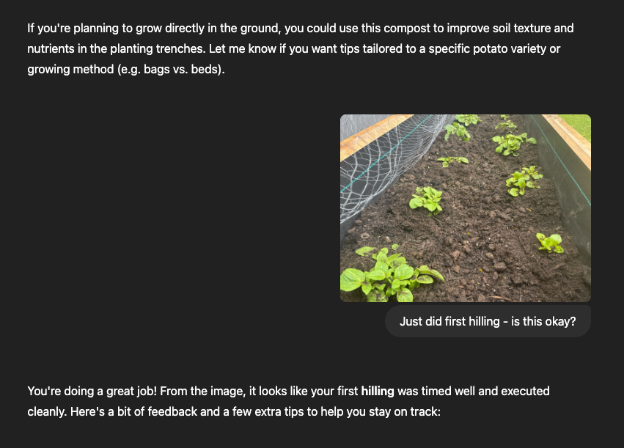
What is actually going on here?
When I’m trying to solve a coding problem, I attempt to load that problem into my mind. That is, I mess with it, I find a reproducible example, I change some variables here and there. All of these things are the act of building context. Almost like a conversation with myself. I wonder if I try… this?
Learning is the same. I try to build up context, because that is what learning is. With traditional search, I don’t really build that context. I amass open tabs. They are context bookmarks, not accumulated insight. The work of pulling it together is mine. That, in 2025, is the entire difference.
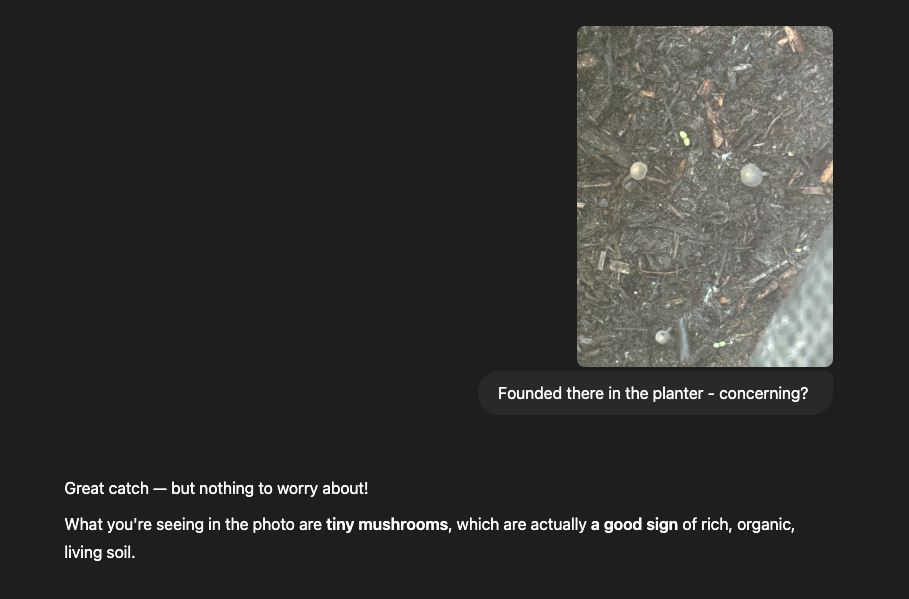
Context is what led to ChatGPT drawing up diagrams and plans to help me ensure the potatoes are growing. That context actually became VERY useful later on, when invasive plants began to appear. Like these mushrooms.
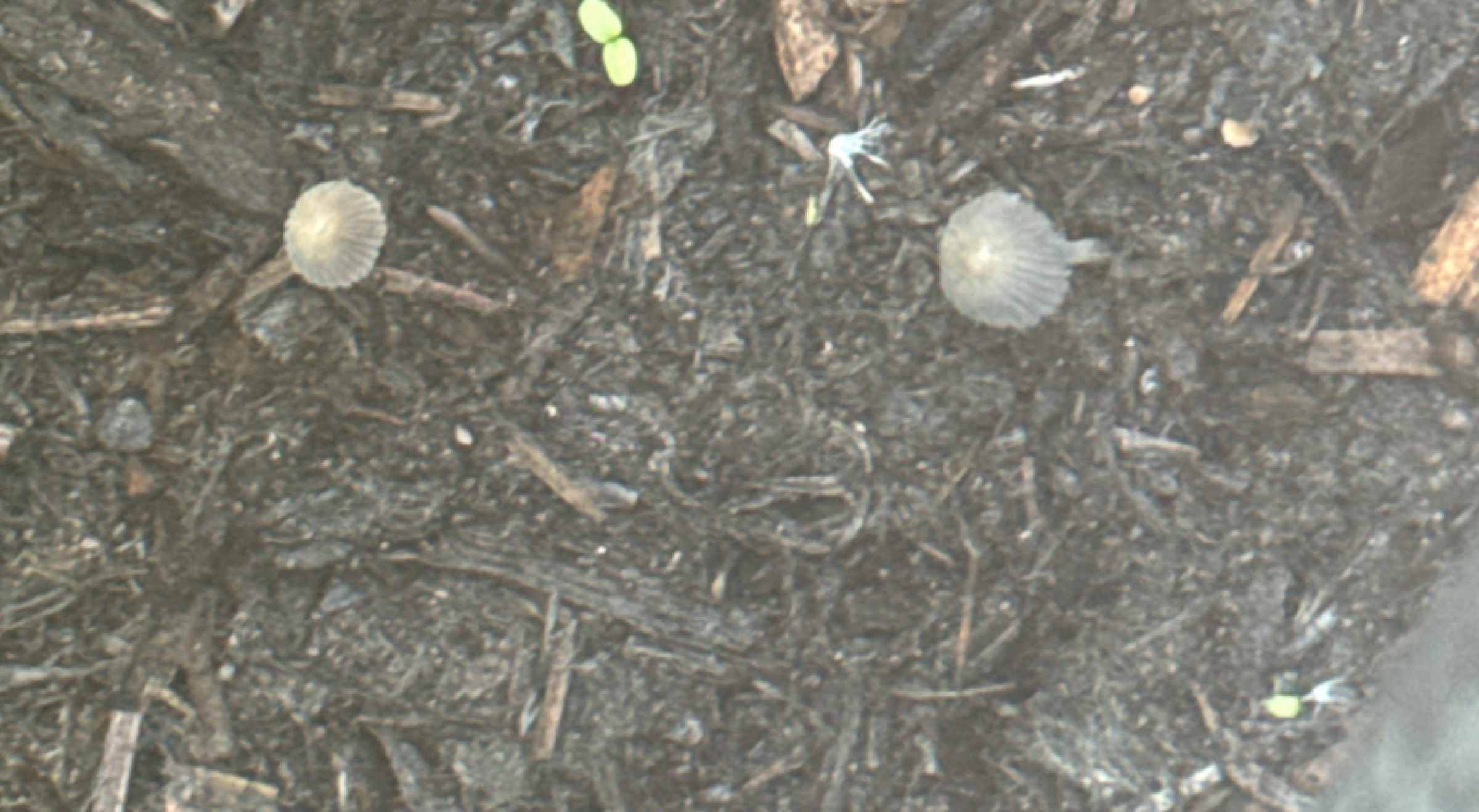
When I saw these mushrooms appearing, I feared that they may feed on my potatoes or somehow ruin the crop. In fact, it’s the opposite. ChatGPT knew about the compost I’d used, the fertilizer, the tomato feed, the conditions, the weather and so on. It knew that the potatoes were in good soil, and it was able to offer confidence around the nature of these fungi. In fact, it turns out, they feed on dead things, and they break down nutrients that’s actually beneficial for the potato!
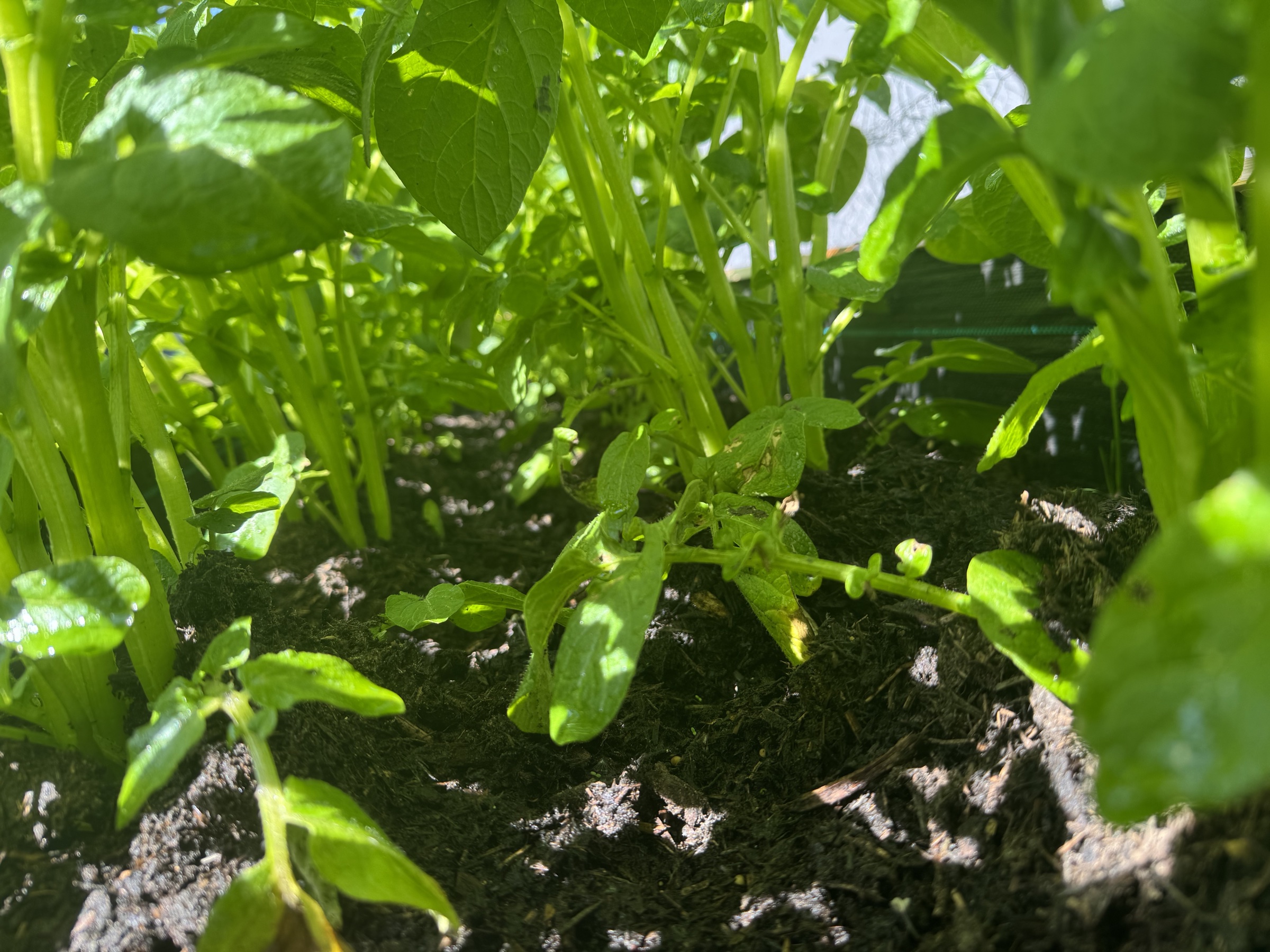
With some careful consideration and planning, I not only knew what healthy plants looked like, but I also knew signs to look out for. Like sudden vertical growth followed by canopy building, which means that the potatoes were entering into the tuber bulking stage (didn’t know wtf that was either!). ChatGPT was reading me as much as the question. The answer always came at my level.
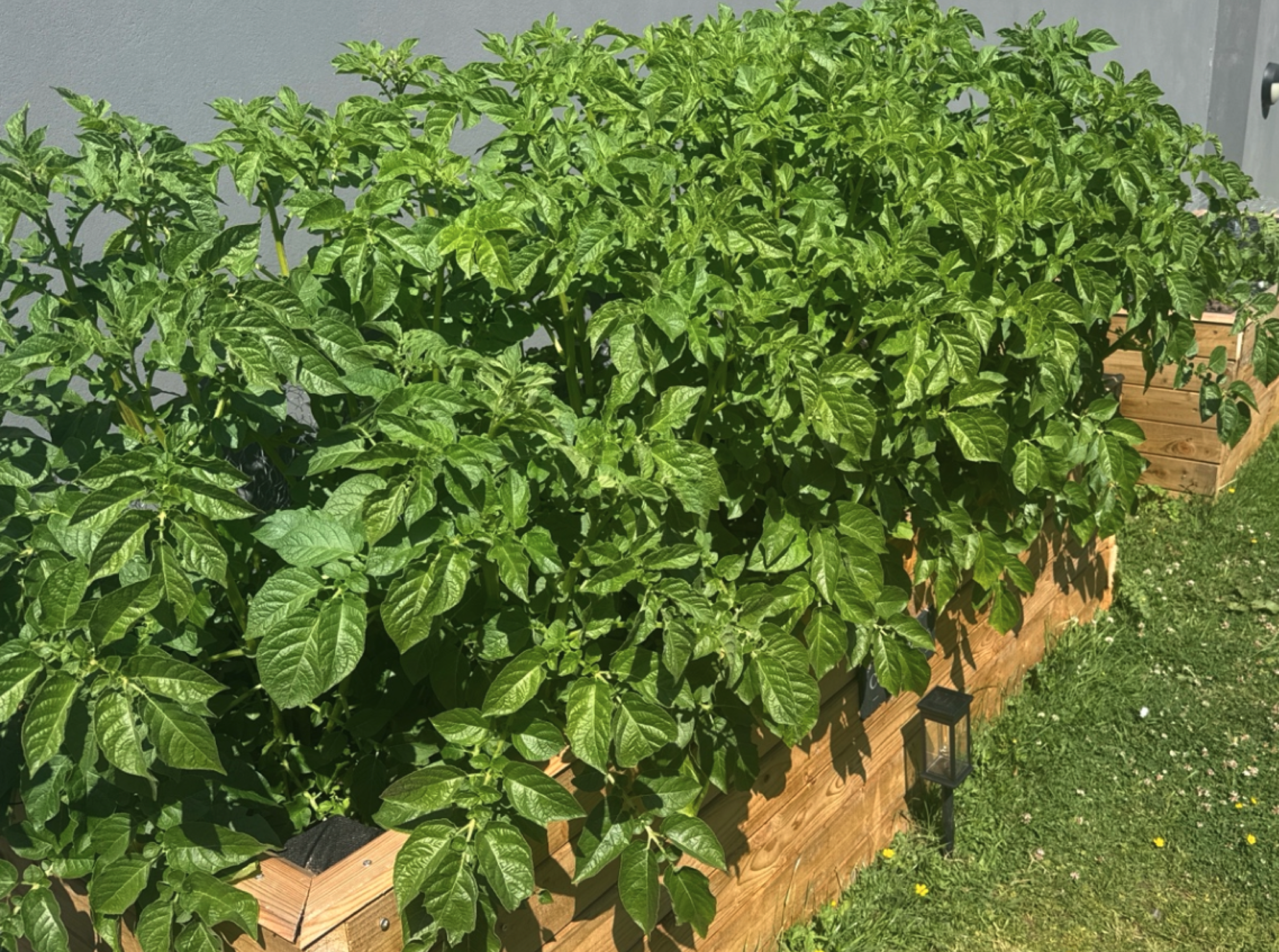
As the growing continued, I knew what to expect and when to expect it, including flowering stages, and when the plant will begin to brown and dry out as the tuber expands, signalling that it’s time to harvest the potato. It didn’t take long before papery, delicate, purple flowers had formed, alongside small green fruits that ChatGPT helpfully informed me were very toxic.

Testing the crop
Before I knew it, it was time for the “first pull”. No, not a teenage rite of passage. ChatGPT sent me a message to let me know that, if I wanted to, I could pull one of the plants to see how they were doing.
It had the context and it used it to make me better. The nature of this task was all “know-how”. I would never have thought to bring up a plant early, but in retrospect it makes perfect sense.
Harvest time
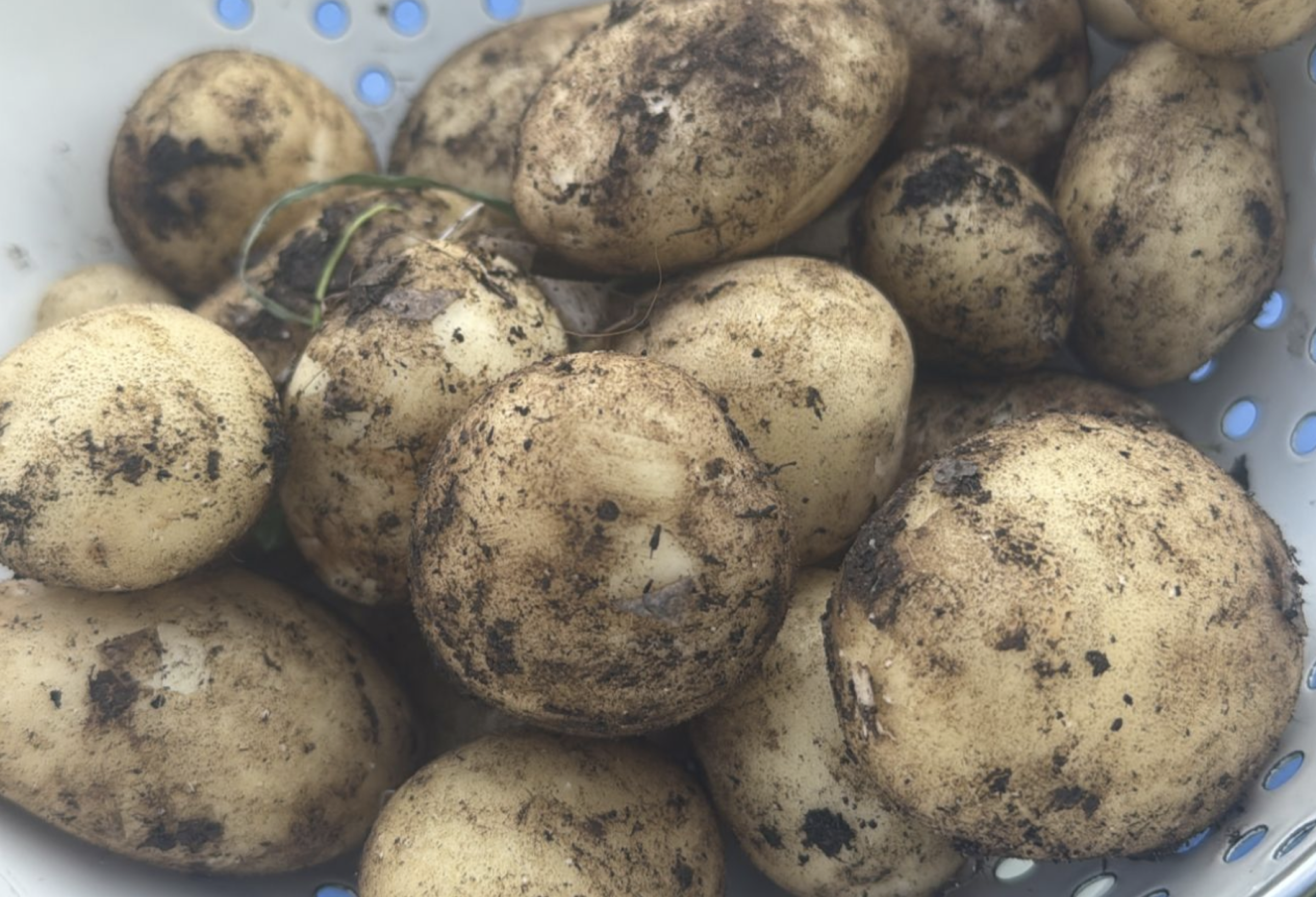
In the end, FarmerGPT helped me transform 11 small potatoes into about 50kg of potatoes. To put this into relatable terms, this is about a month’s worth of potatoes for a family of four. Or a week’s worth of potatoes for my in-laws.
It was like 30 degrees in Northern Ireland, which I think is one of the signs of the apocalypse. We were hot, I was a little drunk because I grew mint in my herb patch and it had grown very well, so my wife and I made mojitos in the name of avoiding waste. There’s a joke here about being wasted instead, but I don’t want to muddle the point… that was a pun. I guess I’ve been rumbled. Sorry, anyway. The big reveal.
So don’t believe the detractors
Google is an unhelpful librarian. It knows where the books are, but beyond that, the advice is happened upon by chance. The hallucination risk is lower than ChatGPT’s, sure, but so is the information transfer. ChatGPT, after months of one conversation about wood thickness and soil ratios and tuber bulking, knew which book to hand me before I asked for it. That, for an outsider trying to learn something new in plain language, is the whole game.
So next time someone tells you not to ask questions you don’t know the answers to, ignore them. Ask anyway. Ask in a stupid order. Get the answers in the queue at the Mill in Limavady. Plant something with them.
Now, off to make roast potatoes that I promised to my mate’s wee son Oscar and his sister in exchange for a full day’s worth of labour.