On 4 January 1960, a car carrying Albert Camus and his publisher Michel Gallimard skidded off a wet road near the village of Villeblevin and hit a tree. Camus died at the scene. He was forty-six. Found in the inside pocket of his coat was an unused return ticket from Paris to Lourmarin: he had decided, at the last minute, to accept a lift instead. The Nobel Prize for Literature, which he had won less than three years earlier, was sitting in his study at home.
Camus had spent his entire writing life arguing that the universe was not in the business of arranging things for us. It was, he wrote, indifferent. Things happened. Often the things were stupid. The car under him, on the day he died, was an extraordinarily fast Facel-Vega, and he had not been driving it.
This is the fourth piece in a series I'm calling "One Great Insight". The first three were Debord, Bulgakov and Wittgenstein. This one is Camus, and it is about why, in spite of and because of all of the above, I think his conclusion is the cheerfullest piece of philosophy produced in the twentieth century.
Who was Albert Camus?
He was born in Algeria in 1913 to a family that had no money. His father was a Frenchman of recent Alsatian origin who worked in a vineyard; he was conscripted into the French army at the start of the First World War and was wounded at the First Battle of the Marne. He died of his wounds in October 1914, when his son was eleven months old. Camus's mother, who was illiterate and partially deaf, raised him with his grandmother in two rooms in the working-class district of Belcourt, in Algiers. There was no electricity worth speaking of, no plumbing of any importance, and not a single book in the house.
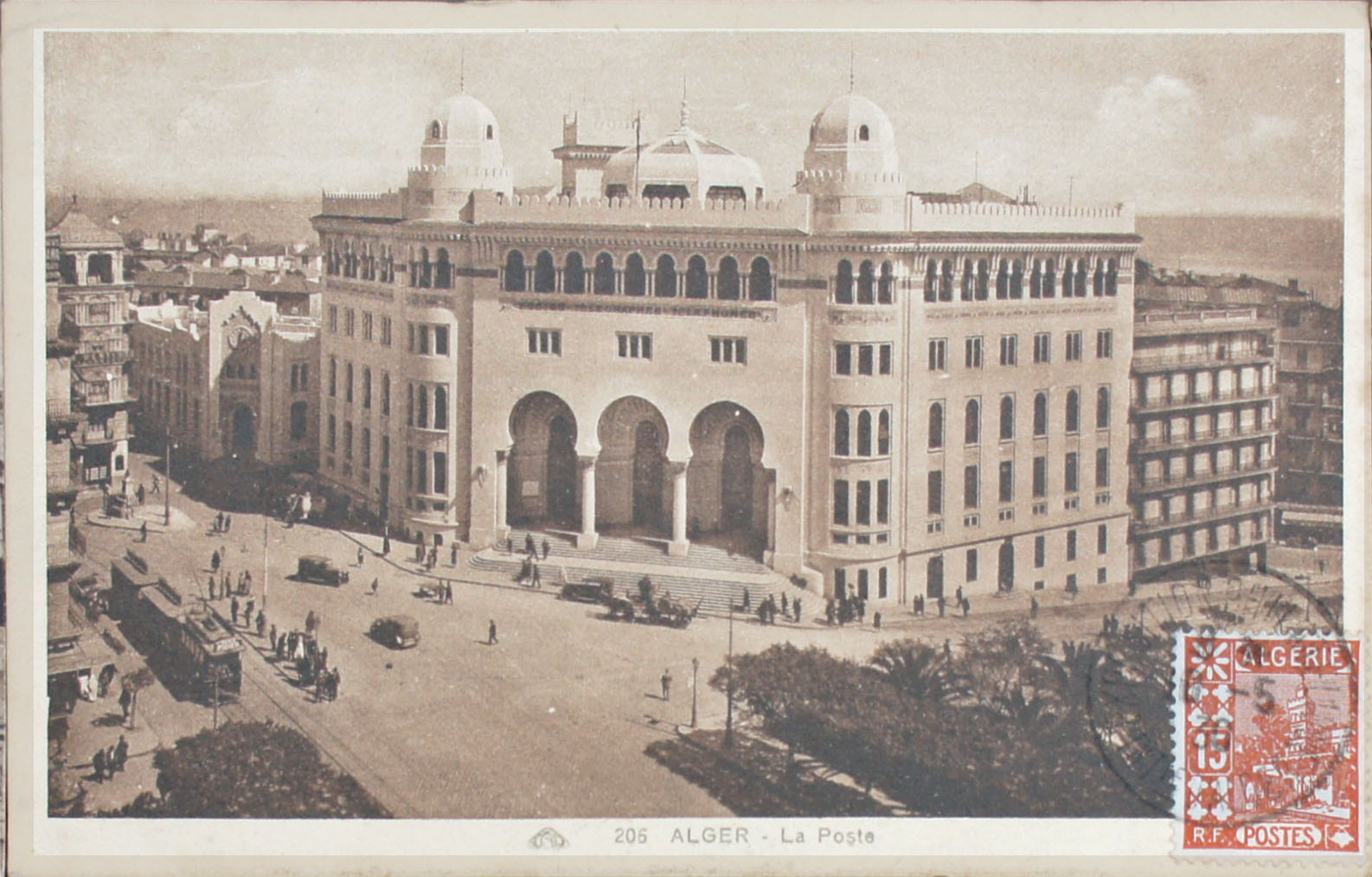
He won a scholarship to a good lycée. He played football for Racing Universitaire d'Alger, in goal, which was the position the family could afford because goalkeepers wore out their boots more slowly than the boys running the touchline. At seventeen he developed tuberculosis. The illness, which would shadow him for the rest of his life, ended both his football and his hopes of becoming a teacher. He started writing.
By 1942 he was in occupied Paris. By 1943 he was editing the underground Resistance newspaper Combat under a false name, and he had finished two books in two years that would, before long, make him famous. The first was The Stranger, or L'Étranger in the original French (some British editions render it as The Outsider, which catches the meaning more exactly). The second was The Myth of Sisyphus, in French Le Mythe de Sisyphe. They are the same book in two different shapes.
The Stranger
The Stranger has a small plot. Meursault, a clerk in Algiers, hears that his mother has died. He attends the funeral without crying. He returns to Algiers and goes to the beach with his girlfriend. A few days later, on a hot afternoon at the same beach, he kills an Arab man he barely knows, with a gun he is carrying for someone else, for reasons he cannot really articulate beyond the fact that the sun was very bright. He is arrested, tried, and condemned to death. The court, in the end, is more interested in the fact that he did not cry at his mother's funeral than in the fact that he killed a man.
What the book does, technically, is sit inside Meursault's head while he refuses to attribute meaning to anything. He likes some things. He dislikes others. He notices the weather. He is honest in a way that nobody around him is. He will not pretend to feel things he does not feel, even when pretending would save his life. The novel is, in a small space, the cleanest portrait of dissociation in twentieth-century fiction. Meursault is not depressed. He is not callous. He is just looking at the world without the layer of socially-mandated meaning that the rest of us paint onto everything we see.
The reader follows him through the murder, the trial and the cell, and at the very end, after he has thrown a chaplain out of his cell for trying to talk to him about God, Meursault says this:
"As if that blind rage had washed me clean, rid me of hope; for the first time, in that night alive with signs and stars, I opened myself to the gentle indifference of the world. Finding it so much like myself, so like a brother, really, I felt that I had been happy and that I was happy again. For everything to be consummated, for me to feel less alone, I had only to wish that there be a large crowd of spectators the day of my execution and that they greet me with cries of hate."
— The Stranger, closing paragraph (trans. Matthew Ward, 1988)
This is the book's last paragraph. It is also the door into Camus's philosophy, because everything in The Myth of Sisyphus is, in effect, an attempt to explain why Meursault is, in that final moment, smiling.
The Myth of Sisyphus
The Myth of Sisyphus opens with the most direct philosophical sentence I know.
"There is but one truly serious philosophical problem, and that is suicide. Judging whether life is or is not worth living amounts to answering the fundamental question of philosophy."
— Albert Camus, The Myth of Sisyphus, 1942
The line is quoted often, and is sometimes paraphrased into a glib internet version about whether to kill oneself or have a cup of coffee, which Camus did not write. The real one is more bracing. He is asking, in his first sentence, whether anything you go on to do is justifiable in the absence of a reason to be alive at all.
He calls the predicament the absurd. The absurd, for Camus, is not the universe's strangeness; it is the gap between the human appetite for meaning and the universe's complete refusal to supply any. A man who looks for meaning long enough and clearly enough finds that the world is not arranged to provide it. The absurd lives in the gap.
He says you have three options.
The first is suicide. You decide that life without meaning is not worth the trouble, and you opt out. Camus does not endorse this; he spends most of the book arguing against it. He is honest enough, though, to say that it is a coherent answer to the question. If life has no meaning, deciding to leave is not stupid.
The second is what Camus calls philosophical suicide. You cannot bear the absurd. You take Kierkegaard's leap of faith, or Lev Shestov's, or any of the dozen variants on offer, and you decide that there is a meaning, given to us by God or by Hegel's Spirit or by History or by some other large source of significance, and you stop asking the question. Camus does not endorse this either. He calls it suicide because what dies is the part of you that was honest about the absurd in the first place. The leap is comforting. It is also a lie you have agreed to tell yourself.
The third is to live with the absurd, openly, without surrendering to it.
This is the move that makes Camus a happy philosopher, and it is the one he spends the rest of the book describing. You do not look away from the gap between human meaning-seeking and the universe's silence. You do not jump out of your life to escape it. You do not paper over it with God or ideology. You stay, you look at it, and you laugh.
Sisyphus was a king of Corinth who lied to the gods and was condemned, for it, to roll a boulder up a hill for eternity. Whenever it nearly reached the top, it rolled back down. He had to walk down after it and start again. The essay's last paragraphs describe Sisyphus walking down the hill, between rolls, in the cool air. Camus writes:
"The struggle itself toward the heights is enough to fill a man's heart. One must imagine Sisyphus happy."
— The Myth of Sisyphus, closing lines
The instruction is not to pretend the boulder is light. The boulder is heavy, the hill is long, the work is futile, and the gods who set the punishment do not care. Sisyphus rolls anyway, knowing all of that, and as he walks back down the hill, in the cool air, in the few minutes that are entirely his, he is happy. He is happy because the universe has refused to give him meaning and he has decided, in defiance, to live well anyway.
Happiness, in Camus, is rebellion.
Camus, Sartre and the rest
Camus arrived in Paris in the early 1940s and was, briefly, friends with Jean-Paul Sartre. The two of them shared a publisher, a literary scene, a left-wing politics, and the same cafés in Saint-Germain. Their wives and their lovers crossed and re-crossed each other's paths. Camus, for his part, was tall, beautiful, knew how to dance, and seduced women in a way Sartre could not, and Simone de Beauvoir, who was Sartre's lifelong companion in an arrangement neither of them ever pretended was monogamous, was reportedly close enough to Camus at one point to make Sartre nervous. De Beauvoir herself once said she and Camus were like two dogs circling the same bone, and the bone was Sartre. There is a great deal more to be said about this triangle, most of it speculative, and the cleaner sources stop at noting that the three of them all had complicated feelings about each other and leave the rest to gossip.
The friendship ended in 1952. Camus had published The Rebel, a long essay in which he argued that revolutionary violence in the name of a future utopia was incompatible with a serious morality. Sartre's magazine Les Temps Modernes ran a hostile review by a young writer called Francis Jeanson. Camus replied. Sartre took up the pen and demolished him personally in print. The two of them never spoke again. Camus, looking back, said that the public mauling had been one of the worst experiences of his life.
The disagreement was, on the surface, about Soviet communism. Sartre was prepared to defend the Soviet camps as an unfortunate stage on the road to a real human emancipation. Camus, who had grown up among people for whom abstraction did not put bread on the table, would not. Sartre called him a moralist. Camus called Sartre a man who would happily watch the present generation be ground up to lubricate a future that would never arrive. They were both right about each other.
Underneath the politics was a difference about the absurd. For Sartre, the absurdity of existence was a cue to commit oneself to a project, to choose, to engage, to redeem the meaninglessness with action. For Camus, the absurdity of existence was a cue to stop pretending that any project would dissolve it. Sartre wanted to fix the world. Camus wanted to stop lying about it. Their friendship lasted exactly as long as that distinction did not have to be drawn in public.
Why this matters
Most of the time, the absurd in our lives is small and managed and survivable.
It is the meeting in which a target is set for next quarter, then revised in the meeting next quarter, then revised again in the meeting after that, until the target you have chased for a year has rotated through three numbers and you can no longer remember why you were chasing it. It is the news cycle in which a trillion dollars of equity value notionally evaporates in a week and your job is unaffected and your bins still need taking out. It is the GDP figure that goes up while your weekly shop also goes up. It is the announcement, in some city you have never been to, that things are now different in some sector you do not work in. The world tells you that important things are happening. None of them, on any given Tuesday, happen to you.
The temptation, when this is the texture of the world, is one of the two suicides. You can declare it intolerable and walk out of your own life, which most of us, mercifully, never do. You can paper it over with a story large enough to make the texture seem secondary: the religion, or the politics, or the ideology of your employer's business unit, or a heroic narrative about your own life and how all of it is leading up to something. There are many varieties; they all have the same shape. They are all leaps. They all give you, in exchange for the gift of taking the absurd seriously, a measure of comfort the absurd was not going to give you on its own.
Camus's third option is to refuse both. You stand inside the meeting, with its imaginary number, and you do the work in front of you. You take the bins out. You call your mother on Sunday. You do not pretend any of it is part of a plan. You do not need it to be part of a plan. The work is its own thing. The bin is its own thing. The walk back down the hill, in the cool air, is, in the strict Camusian sense, plenty.
Reading it now
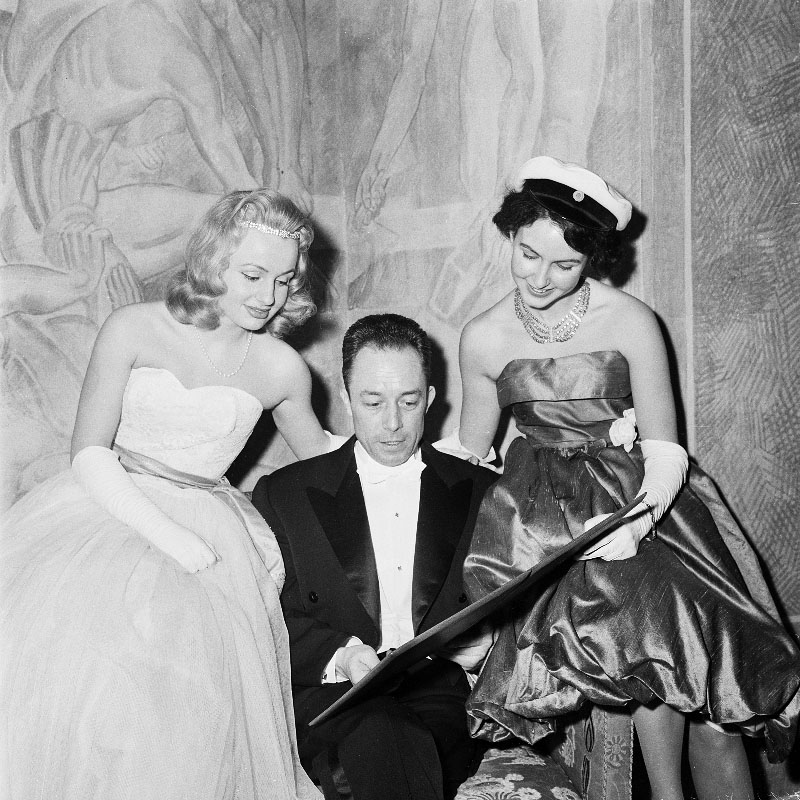
Camus died in a car crash because his publisher drove too fast in the wet. The unused train ticket in his pocket has, ever since, been the favourite detail of every essay anyone has written about him, mine included, because the absurd seems to have a sense of humour even at the level of biography. The man who taught Europe to live with the indifference of the universe was killed by the indifference of the universe at forty-six.
What he would have wanted us to do about that was nothing in particular. Read the books, or don't. Roll your boulder, or don't. There is no instruction at the end of his philosophy because instruction would have been another leap, another move to fill the gap with something other than what is actually in it.
What he would have wanted us to do, because it is what he wrote, is to imagine Meursault on the night before his execution, lying on the bed in the cell, with the door closed and the light on, opening himself, against everything the world had done to him, to the gentle indifference of it. To feel happy. To wish, as a free man's last wish, for a crowd at the gallows that would greet him with cries of hate.
That's the great insight.